
In House IT vs Outsourced: Which Fits Best?
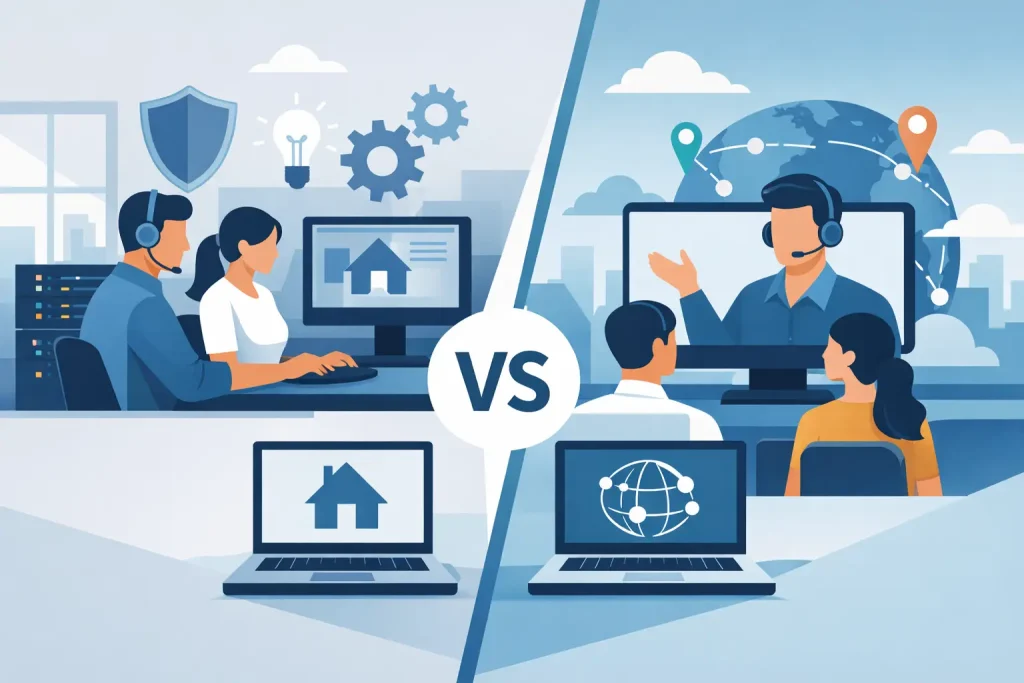
When a server fails at 8:45 on a Monday morning, the question is not whether your IT model looks good on paper. It is whether somebody can fix the problem quickly, keep your team working and stop a small issue turning into a lost day. That is why the choice between in house IT vs outsourced support matters so much for growing businesses.
For some organisations, building an internal team makes perfect sense. For others, outsourcing gives better coverage, better value and far less management overhead. The right answer depends on your size, your risk profile, your budget and how much technology really underpins your day-to-day operations.
In house IT vs outsourced: what is the real difference?
An in-house IT setup means your business employs its own IT staff directly. They might handle helpdesk issues, hardware, user accounts, cyber security, supplier management and longer-term planning. In some firms, that is one person wearing several hats. In larger businesses, it could be a whole department.
Outsourced IT means an external provider takes responsibility for some or all of those functions. That could include remote support, on-site assistance, cyber security, Microsoft 365 management, procurement, telephony, cloud services and strategic advice. In effect, you gain access to a wider technical team without hiring each role yourself.
Neither model is automatically better. The real question is which one gives your business the support, resilience and expertise it actually needs.
When in-house IT makes sense
If your organisation has highly specialised systems, a large user base or constant internal development needs, an in-house team can be a strong fit. Having dedicated staff on site can make communication faster and give you people who know your business inside out. They understand the personalities, the workflows and the operational quirks that never make it into documentation.
There is also a sense of direct control. You manage priorities internally, shape the team around your goals and keep knowledge close to the business. For companies with the scale to support a proper IT function, that can work well.
The difficulty is that many small and mid-sized businesses do not have the budget to build a complete team. One internal IT manager may be excellent, but no single person can be a specialist in infrastructure, security, compliance, cloud platforms, telephony, procurement and user support all at once. Holidays, sickness and staff turnover also create risk. If one key person holds most of the technical knowledge, that becomes a business continuity issue.
When outsourced IT is the better fit
Outsourced IT tends to suit businesses that need dependable support but do not need, or cannot justify, a full internal department. Instead of relying on one or two employees, you get access to broader expertise across different areas of IT.
That matters more than many businesses first realise. Modern IT is not just about fixing laptops. It covers cyber security, backup, licensing, cloud systems, remote working, compliance, procurement, connectivity and planning for future growth. Outsourcing can put all of that under one roof.
It can also improve responsiveness. A good provider should have processes, coverage and escalation paths in place, so issues are not left waiting while one overstretched person juggles every task. For firms with hybrid teams, multiple sites or operationally critical systems, that wider support model often gives better resilience.
This is especially true in sectors such as dental and healthcare, where downtime affects more than inboxes and spreadsheets. If clinical systems, phones or network access are disrupted, appointments and patient service can suffer very quickly. In those environments, practical support and sector knowledge are not nice extras. They are essential.
Cost is not just salary
One of the biggest mistakes in the in house IT vs outsourced discussion is comparing a managed service fee with one employee salary and stopping there. The real cost of in-house IT is much wider.
You need to factor in salary, National Insurance, pension contributions, training, recruitment, holiday cover and the cost of tools the team needs to do the job properly. If you want broad expertise, you may need more than one person. That is before you think about the cost of downtime when a problem falls outside your internal team’s skill set.
Outsourced support usually gives a more predictable monthly cost. That can make budgeting easier, especially for smaller firms trying to control overheads. It does not mean every outsourced contract is cheaper in every situation, but it often means better value for businesses that need access to multiple skills without building a full department.
The cheaper option on paper is not always the more economical one in practice. If poor support leads to recurring outages, cyber risk or slow-moving projects, the hidden cost to the business can be significant.
Expertise, coverage and risk
This is often where outsourced IT pulls ahead.
An internal IT person may be very capable, but they still have limits. No one individual can stay equally strong across every system your business relies on. Cyber threats change quickly. Cloud platforms evolve. Vendors update products all the time. Compliance expectations shift. Expecting one person to keep pace with all of that is unrealistic.
An outsourced provider should bring a team with different strengths. That means one issue can be handled by a support engineer, another by a cyber security specialist and another by someone focused on infrastructure or cloud services. The result is not just broader knowledge, but a lower operational risk when something complicated happens.
Coverage matters too. Businesses do not stop needing support because it is lunchtime or because your IT manager is off sick. Shared knowledge, documented systems and a team-based approach usually create a more stable support model.
Control versus capacity
Some business owners worry that outsourcing means losing control. That can happen if the provider is hard to reach, slow to respond or poor at communication. But good outsourced IT should feel like an extension of your business, not a distant third party.
What matters is clarity. You need to know who is responsible for what, what response times look like, how issues are escalated and how strategic decisions are discussed. If those things are clear, outsourced support can actually improve control by giving you better structure, visibility and accountability.
In-house IT gives more direct day-to-day oversight, but that does not always mean greater capacity. If your internal team is stretched thin, control can become theoretical. You may know who is responsible, but they still may not have the time or specialist knowledge to deal with the issue properly.
The hybrid model can work well
It is not always a straight choice between one model or the other.
Many businesses use a hybrid approach, where an internal IT lead works alongside an outsourced provider. That can be a very effective setup. Your internal person understands the business closely and manages local priorities, while the outsourced partner adds specialist expertise, service desk support, cyber security tools and cover when needed.
For growing organisations, this often gives the best balance. You keep internal oversight without expecting one employee to carry the full weight of support, planning and security. It can also be a sensible stepping stone for businesses moving from reactive IT support to a more structured service model.
Looking for Fully Managed IT Support?
Many organisations choose a managed IT support model because it provides access to a wider team of specialists without the cost of building an internal department. From helpdesk support and Microsoft 365 management to Cyber Security and strategic IT planning, outsourced support can provide the expertise and coverage growing businesses need.
Learn more about our Managed IT Support Services →
How to decide what fits your business
If your business has fewer users, limited internal technical leadership and a need for dependable day-to-day support, outsourced IT is usually the more practical route. It reduces hiring pressure, broadens the skill set available to you and helps create continuity.
If you are a larger organisation with complex internal systems, enough budget for a real team and a constant volume of IT work, in-house support may be justified. Even then, many firms still outsource selected areas such as cyber security, cloud projects or telephony.
Ask yourself a few simple questions. Do you need one person, or do you really need a team? What happens when your key IT contact is away? Are your current arrangements helping you plan ahead, or just firefighting? If systems went down tomorrow, how confident would you be in the response?
Those questions usually reveal more than a spreadsheet comparison ever will.
For many UK businesses, especially those that want responsive support without the cost and complexity of building a full department, outsourcing is the model that makes day-to-day operations easier. That is why so many firms work with providers such as Terahost – not just to fix issues, but to keep systems stable, secure and ready for growth.
The best IT model is the one that lets your team get on with their work, knowing the technology behind it is properly looked after. If your current setup leaves too much resting on one person, too much downtime risk or too many loose ends,